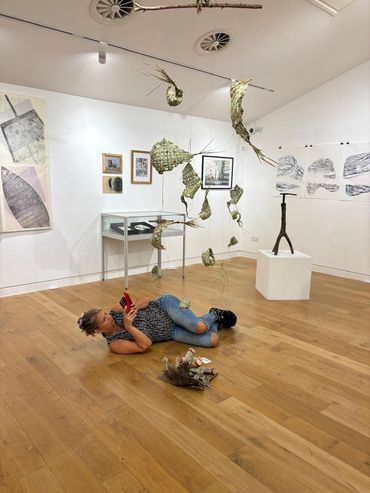
This work was created in response to a selection of wooden museum objects chosen by Liz Botterill (museum curator), and Rosalind Barker and Sue Evans (gallery co-facilitators).
Seeing these wooden objects together prompted reflections on the role of the museum and the curator in preserving history and culture, acting as a kind of window into the past. The use of wood as a material also highlights the local, natural resources that were available before industrialisation and global trade. Beyond that, the way these items were curated raised questions for me: What narratives are being told through these groupings? Why were they chosen, and why together? While all the items were made of wood, they also seemed to reflect aspects of domestic life, craftsmanship, and even societal wealth. Their very existence suggests that the people who made them had time — time to carve, time to prepare straw for hats, and time to play!
As I was going to be in Egypt during June and July, I approached this project from a different perspective — physically and culturally. The original wooden objects were handcrafted in England, where wood is abundant. But how could I respond to that while in Egypt’s Red Sea region, a place defined more by desert and sea than by forests?
This contrast brought into focus how environment shapes culture and material history. Although ancient Egyptians used wood, much of it was imported, even in the Old Kingdom, where there are records of ships delivering wood to Egypt. Another constraint was practical: I was travelling light, just a small backpack on an EasyJet flight, so whatever I made needed to be compact and airport security-friendly.
In my garden, I had a couple of different kinds of palm trees and a Eucalyptus tree, Eucalyptus Camaldulensis/River Red Gum Eucalyptus which was brought to Egypt in the 1800s by Mohamed Ali to reinforce and protect the banks of the Nile). While palm tree wood wasn’t suitable as the palm tree was still alive! I could work with the fronds, which are commonly used in Egyptian basketry. As I experimented with eucalyptus branches and leaves, a large, low-hanging branch unexpectedly broke, so I cut a small branch in to sections that fit into my backpack.
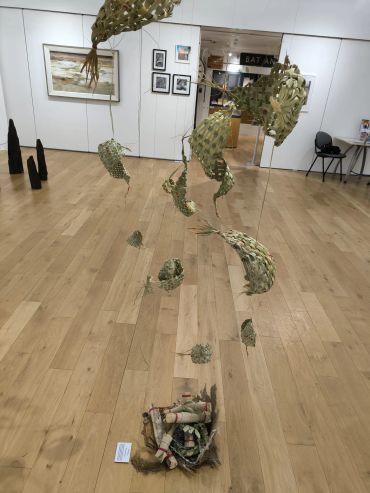
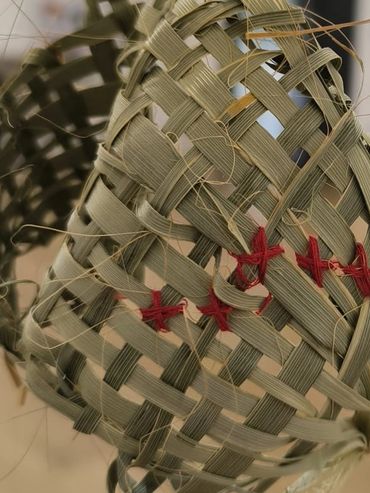
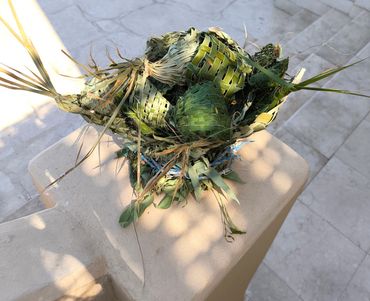
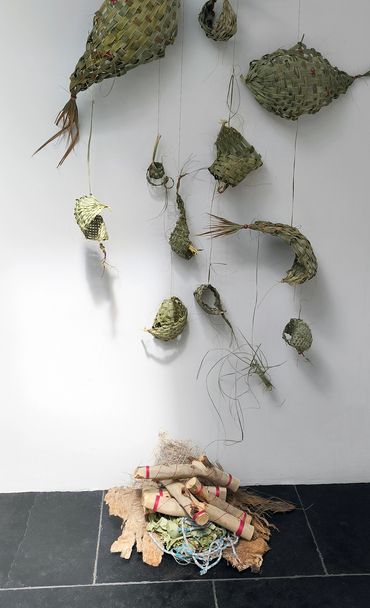
My resulting installation is composed of: Woven palm leaves, eucalyptus wood and leaves, red thread (hinting to celebrating and preserving culture through traditional embroidery in the region, and reflecting on my personal background and history), and a rope fragment from a kitesurfer’s kite, an offering from the sea!
Just like the museum collection, these elements speak to the environment and context in which they were made. The baskets, initially fresh and green, could carry objects — but once dried, they became fragile, evoking memories of a possible ancient past. The eucalyptus rings (which reminded me of the rings of cloth Egyptian women living in remote villages put on the heads to balance big pots of water collected from the Nile), once aromatic and supple, are now brittle and easily broken. The cut Eucalyptus branch with beautiful natural markings kept bare, wrapped in red thread, may be seen as a ceremonial or decorative item.
And if these objects were discovered centuries from now — what stories might they tell?